


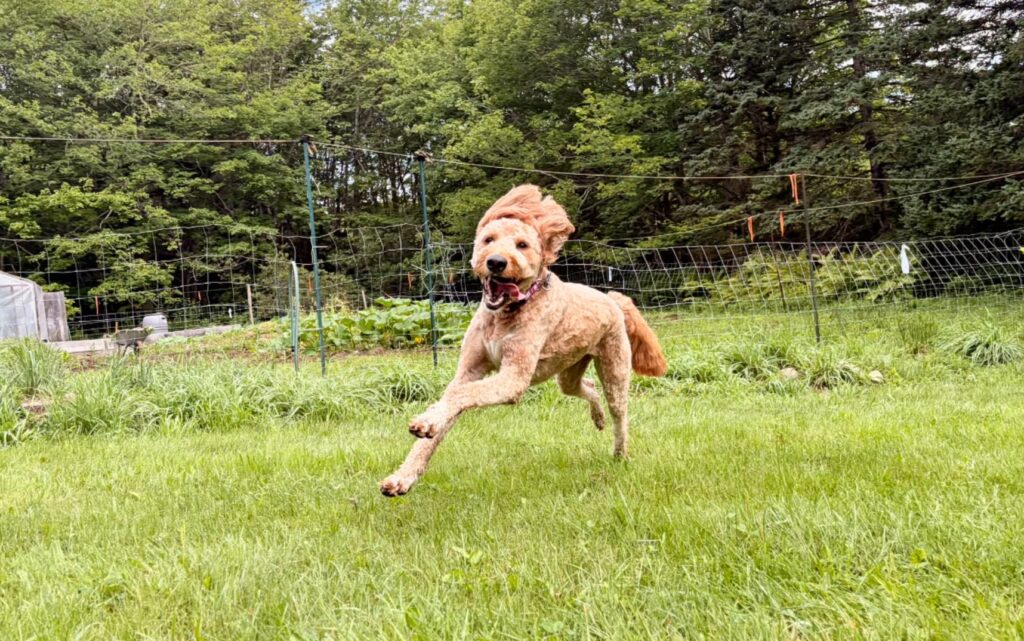
Flight is part of the body’s survival response to perceived danger. When a dog experiences an intense enough scare, the sympathetic nervous system kicks in and stress hormones such as adrenaline and cortisol rise. The brain becomes much more focused on one job and that is
“  GET AWAY FROM THE THREAT ”
At that point, things we normally think of as reliable can temporarily become much less important to the dog.
Things like their name, their recall skills, food, a familiar car, even familiar people.
It doesn’t mean the dog has forgotten their family or suddenly “doesn’t listen.”
It really means the nervous system is now prioritizing survival
Once a dog is frightened enough, every additional scary interaction can keep that response going.
Interactions that seem helpful in the moment, such as:
- approaching them
- calling repeatedly
- following them in a vehicle
- searching through the woods
- shining lights toward them
- or trying to corner them
They may be completely well-intentioned and still cause the dog to run again. It will also probably make them think
“Oh I am absolutely right to be terrified right now”,
pushing them further away.
If you see a missing dog who appears frightened, do not chase them.
In fact, one of the most useful things you can do is simply become an observer.
If possible, get a photo or video without approaching, and record:
- exact location
- exact time
- direction of travel
- what the dog was doing
- whether they stopped, ran, crossed a road, entered woods, etc.
Then report it to the person coordinating the search.
Those pieces of information become incredibly valuable when sightings are plotted on a map.
Roads, old rail beds, logging roads, trails, shorelines, clear-cuts and other paths of least resistance can start revealing a travel pattern.
Don’t assume no sightings means the dog has left… this was probably one of the biggest lessons reinforced for me.
A frightened dog can hunker down incredibly well, they may rest for hours.
They may travel when the area becomes quieter, they can be in the same woods people are searching and never make themselves known.
There were times during this search when we were almost certainly very close to Millie, and we still couldn’t see her.
Despite human instinct, sometimes the answer isn’t to search harder,
it’s to try and create less pressure and wait for more information.
Food and scent can help create a safe place to return to.
In our search we used a feeding station with very smelly food, including barbecued hot dogs and bacon, along with familiar blankets and a cellular trail camera.
Another trick shared with us was hanging scent bags with meat in strategic areas so the smell could carry without requiring people to constantly move through the area.
If you use food stations, cellular trail cameras are incredibly helpful, this way you can know that something ate the food without knowing whether it was your dog, a raccoon, a fox, a coyote, or the neighbourhood cat enjoying a bbq buffet (my cat Axel  ).
).
Once you can establish that the missing dog is regularly visiting one location, recovery becomes much more targeted.
Technology can help you search without pushing the dog’s nervous system over the edge.
Thermal drones can sometimes identify movement or heat signatures without sending people deep into an area where a frightened dog may be hiding.
Trail cameras can monitor feeding stations, trails and travel corridors 24/7 without a person standing there.
Both can help gather information while keeping human pressure low.
Be careful with nighttime searching!
You obviously need enough light to keep yourself safe, but constantly sweeping bright flashlights through the woods can make a frightened animal less likely to move toward you.
Quiet observation, listening with headlights off when safely parked, minimal movement, and giving the dog space can sometimes be much more productive than walking through the woods calling their name.
Familiar people may still need to wait, and this might be the most fascinating part of the whole thing for me.
When Millie was finally located, her owner stayed nearby instead of pursuing her. Millie came out of the woods and saw her owner… and went back into the woods. She came out again later, she looked, processed, used her senses, and after a few moments realized “there’s mom!”.
Only then was her owner able to get her safely.
I have to think about what that tells us…
Even seeing one of the most familiar and important people in her world wasn’t enough to instantly override that survival response. She needed time for her nervous system to process what she was seeing and determine that she was safe.
That is why patience after a sighting can be so incredibly important.
Also, don’t forget where the dog originally disappeared.
Dogs can cover surprising distances, and obviously every situation is different, but don’t automatically abandon the original area just because there have been sightings elsewhere.
Millie travelled through roads, trails and wooded corridors, disappeared for long stretches… and ultimately returned to essentially the same area she had disappeared from, at roughly the same time of day.
Sometimes the best thing we can do for a frightened missing dog is make familiar places safe, quiet and predictable enough for them to find their way back.
The biggest thing I took away from this experience is that recovering a frightened dog isn’t necessarily about having the biggest search party or covering the most kilometres.
Sometimes it’s about doing less, watching more, collecting good information and understanding what fear is doing to the dog’s brain and nervous system.
If you ever see a post about a frightened missing dog in your community,
please read the instructions from the people coordinating the search before heading out to help.
A timestamped sighting from someone who calmly watched the dog disappear down a trail
can be worth far more than ten people chasing after them.
And if sharing what we learned through Millie helps another frightened dog get home someday,
then that feels worth talking about.
